
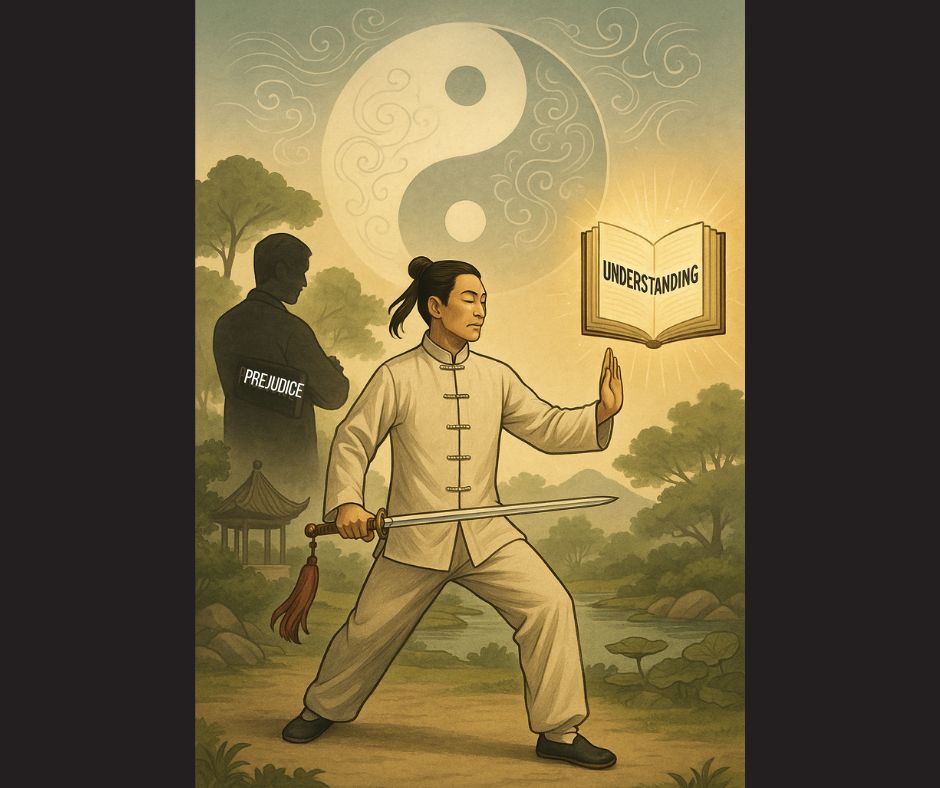
Recently, upon my return from China, I had a conversation with someone of Chinese descent that left me both surprised and reflective. When I shared that I teach Tai Chi classes, they remarked that they used to enjoy practicing the form, including Tai Chi Sword and Fan. However, when I invited them to join our practice sessions, they declined—explaining that they had stopped practicing Tai Chi due to their religious beliefs.
I was surprised by this response. I explained that Tai Chi is a form of exercise, no more religious than Jazzercise. But they remained unconvinced, and I respectfully let the matter rest. It was clear that their views had been shaped by a fundamentalist Christian perspective and that they were not open to alternative ideas.
This encounter reminded me of a quote that has stayed with me since junior high school. Our local newspaper published a “quote of the day,” and among all the wisdom I encountered, one phrase stood out:
“Condemnation without investigation perpetuates ignorance.”
I don’t recall the author, but its truth has remained with me.
Tai Chi does incorporate Taoist philosophy. The Tai Chi symbol—more widely recognized in the West as the yin-yang symbol—teaches that all things contain their opposites. We must examine and learn from both sides of what we encounter. In practice, if someone uses hardness, we respond with softness; if they are soft, we can be firm. Sinking gives rise to rising. These opposites define and depend on each other.
Mastering Tai Chi requires training and discipline—but above all, it requires receptivity. This brings to mind a post I wrote previously about Master Wu’s teaching: that someone may exhibit perfect form yet lack internal strength. You could only truly gauge their skill by making physical contact. In other words, we cannot judge a book by its cover—we must read it to understand what it contains.
While Tai Chi draws on Taoist principles, it is not a religious practice. It is rooted in natural laws of balance, harmony, and health—not in worship, doctrine, or divinity. To label Tai Chi as “evil” or incompatible with one’s faith, without taking the time to investigate what it truly is, is itself a form of spiritual contradiction.
The irony is clear: in rejecting Tai Chi based on unfounded religious concerns, one violates a fundamental value shared by many faiths—the call to seek understanding before making judgments. True wisdom, regardless of religious background, calls for thoughtful examination rather than knee-jerk reactions rooted in fear or misinformation.
If more people applied the principle of investigation before condemnation, perhaps fewer artificial barriers would stand in the way of discovering the profound health benefits and quiet wisdom Tai Chi offers. And perhaps, too, we’d find more compassion and tolerance in this world.


Leave a Reply