
The Hidden Strength Behind Beautiful Movement
Recently, I had an extraordinary opportunity that deepened my understanding of Tai Chi in ways I hadn’t expected. Through the generous introduction of my Chinese friend Wang Xu (Helena), I spent a remarkable day with her Tai Chi teacher, Wu Laoshi, and his instructor, Master Dai—both accomplished masters residing in Hangzhou, China.
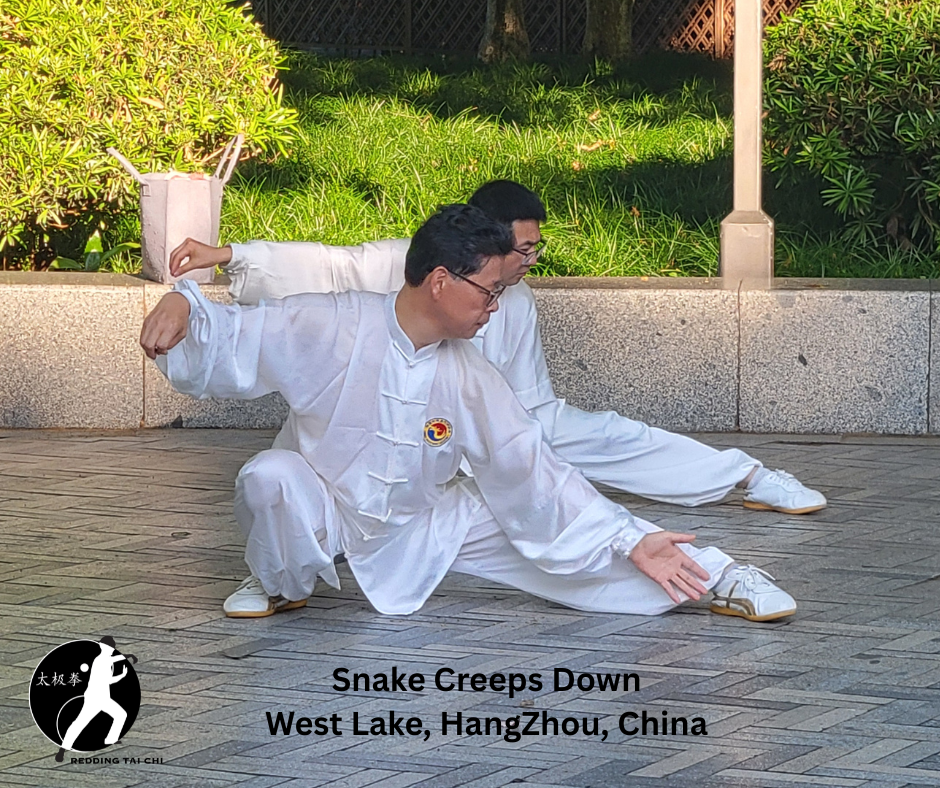
Among the many topics we discussed, one observation particularly struck me: the difficulty of determining a practitioner’s true strength simply by observing their form alone.
The Illusion of Appearance
Wu Laoshi explained that while a student might demonstrate excellent form—beautiful, flowing movements that appear textbook perfect—this external beauty doesn’t necessarily indicate internal strength or practical ability. The true test of Tai Chi skill, he suggested, lies not in what the eye can see, but in what can only be felt through direct contact.
“You can have perfect form but little strength,” Wu Laoshi noted. “Or sometimes, someone with less refined external appearance may possess remarkable ability.”
The Touch Test
To demonstrate this principle, Wu Laoshi offered a simple but revealing exercise. He extended his arm and invited me to hold it firmly while he performed various internal adjustments—pressing, pushing, and pulling with his intention.
What I experienced was remarkable: while his arm appeared completely still and unchanged to the eye, my hands could feel distinct variations in his internal energy. The arm’s position never wavered, yet I could sense different forces moving through his structure—sometimes firm resistance, sometimes yielding softness, sometimes a subtle redirection of energy.
This demonstration revealed a fundamental truth about Tai Chi that many practitioners overlook in their pursuit of perfect external form.
The Hidden Dimension
This experience illuminated why traditional Tai Chi emphasizes tuishou (push hands) and SanShou practice so heavily. Through tactile sensitivity, practitioners develop:
–Internal awareness of energy flow and structural integrity
-Listening skills (ting jin) to perceive an opponent’s intentions
–Responsive power that adapts moment by moment
–Connection to one’s center that may not be seen but only felt.
Wu Laoshi’s perspective challenges the common approach of judging Tai Chi purely on visual aesthetics. While beautiful form certainly has value—and shouldn’t be dismissed—it represents only the visible surface of a much deeper art.
Implications for Practice
This insight raises important questions for all Tai Chi practitioners:
Are we focusing too heavily on external appearance at the expense of internal development?
Many students spend years perfecting the visual aspects of forms while neglecting the cultivation of internal sensitivity and strength. While both elements are important, the masters in Hangzhou reminded me that the invisible qualities often matter more than the visible ones.
How do we develop what cannot be seen?
The answer lies in partner practice, sensitivity training, and honest self-examination. We must be willing to have our internal development tested through interaction with others, not just admired in solo practice.
A Balanced Approach
Wu Laoshi and Master Dai weren’t dismissing the importance of good form—both demonstrated impeccable external technique. Rather, they were emphasizing that form and function must develop together. Beautiful movement without internal substance is merely dance, while internal power without refined expression lacks the elegance that defines true Tai Chi mastery.
Their teaching reminded me that Tai Chi is ultimately about integration: the seamless blending of external beauty with internal strength, visible grace with invisible power, form with function.
Reflection
As I continue to advance in my own Tai Chi practice, this experience in Hangzhou serves as a powerful reminder to look beyond the surface. The most profound aspects of this ancient art often remain hidden from casual observation, revealed only through dedicated practice, sensitive touch, and the guidance of experienced teachers.
The next time you watch someone practice Tai Chi—or examine your own practice—remember Wu Laoshi’s wisdom: true strength may be invisible to the eye, but it will always be evident to the educated touch.
What has your experience taught you about the relationship between form and function in Tai Chi? Have you encountered moments where internal reality differed from external appearance?
Special thanks to Wang Xu (Helena) for facilitating this incredible learning opportunity, and to Wu Laoshi and Master Dai for their generous sharing of wisdom.

M. Czehatowski with Wu Laoshi


 Redding Tai Chi
Leave a comment