
Unraveling the Terminology Behind Tai Chi
As interest in Tai Chi continues to grow, so do the various ways in which this movement art is practiced. Originally rooted in martial arts and physical exercise, Tai Chi has grown into a multifaceted practice with various schools of thought, each emphasizing unique aspects of the art. Today, Tai Chi is practiced as a spiritual and meditative exercise, a therapeutic and rehabilitative practice, a community and social activity, and as originally intended – as a martial art.
Regardless of how Tai Chi is practiced, understanding the terminology surrounding it can deepen your appreciation and knowledge of this ancient art. Let’s start with the name itself: Tai Chi.
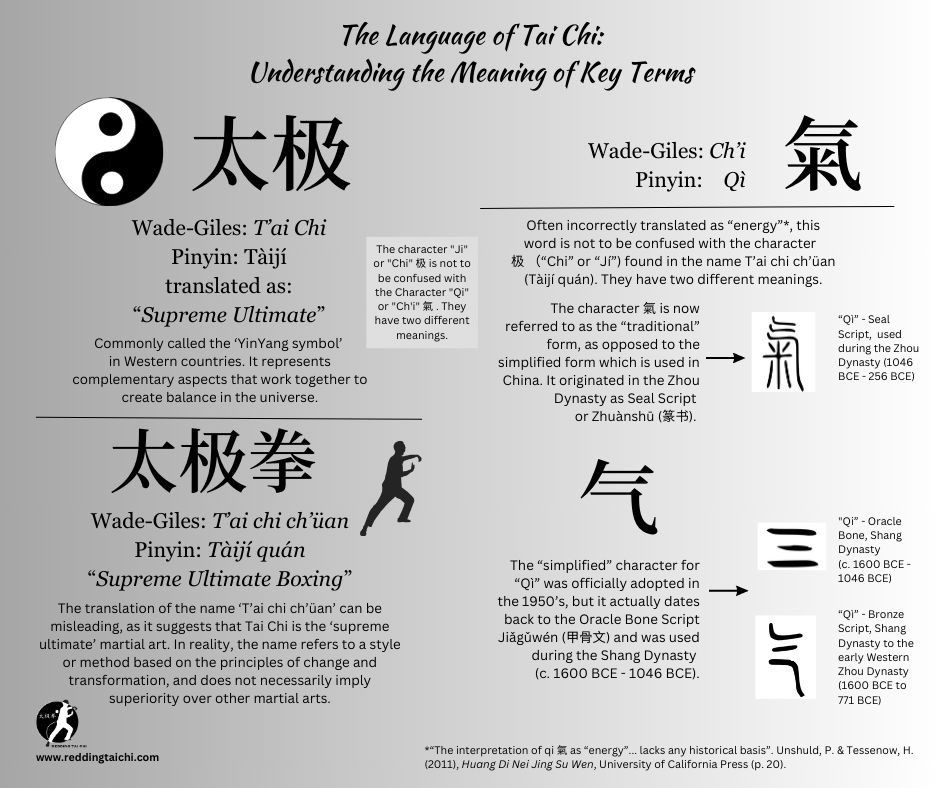
The Name Tai Chi (太极)

The Tai Chi diagram is commonly known as the Yin-Yang symbol in Western countries. The term Tai Chi translates to “Supreme Ultimate” and refers to the primordial unity from which yin and yang emerge. It is a central image in Chinese philosophy, representing the dynamic interplay of complementary opposites.
• In the Wade-Giles romanization system, it is written as: T’ai Chi.
• In the modern Pinyin system, it is written as: Tàijí.
Because Tai Chi was introduced to the West using the Wade-Giles spelling, that transliteration has become widely recognized. Few people are familiar with the correct Pinyin spelling, Tàijí, but regardless of which version you use, it doesn’t change what you are learning and practicing.
Tai Chi Chuan (太极拳)
You may also encounter the term Tai Chi Chuan, which translates to “Supreme Ultimate Fist” or “Supreme Ultimate Boxing.” This refers to the martial art that embodies the principles of Tai Chi.
• In Wade-Giles, it is written as: T’ai chi ch’üan.
• In Pinyin, it is written as: Tàijí quán.
Clarification: The translation of Tai Chi Chuan can be misleading, as it might suggest that Tai Chi is the “supreme ultimate” martial art. This has led some martial artists with an interest in Tai Chi to mistakenly believe that Tai Chi practitioners should be superior fighters. In reality, the name refers to a style or method based on the principles of change and transformation, not necessarily superiority over other martial arts.
The Word Qi (氣)
Now, let’s tackle the more complex term: Qi (often spelled Chi in older systems).
• In Wade-Giles, it is written as: Ch’i.
• In Pinyin, it is written as: Qì.
The word Qi is often incorrectly translated as “energy.” This term should not be confused with the character 极 (Jí or Chi), which appears in the name Tai Chi Chuan (太极拳). These two characters have entirely different meanings. Unfortunately, this misunderstanding has led to incorrect translations of Tai Chi as “Great Energy” or “Cosmic Energy.”
As for the translation of Qi as “energy,” while this interpretation is pervasive in English-speaking countries, it lacks historical accuracy. Paul Unschuld, a leading scholar and translator of Chinese medical texts, explains that
“The interpretation of qi 氣 as ‘energy’… lacks any historical basis.”
— Unschuld, P. & Tessenow, H. (2011), Huang Di Nei Jing Su Wen, University of California Press (p. 20).
If you’re interested in exploring how Qi came to be translated as “energy,” I recommend The Dao of Chinese Medicine by Donald E. Kendall (Oxford University Press, 2002).
Conclusion
Whether you approach Tai Chi as a meditative exercise, spiritual practice, martial art, or social activity, understanding its terminology can deepen your connection to this ancient art. By exploring the meanings behind Tai Chi, Tai Chi Chuan, and Qi, you gain not only knowledge but also a greater appreciation for the philosophy that continues to inspire practitioners worldwide.
A pdf file of “The Language of Tai Chi” chart that you can download is below.
 Redding Tai Chi
Leave a comment