
Proper rising and sinking motions are essential for Tai Chi practice. It is important to always work on coordinating the rising and sinking movements so they happen simultaneously. From the basic movement in the beginning of the form in which your arms raise up in front of you, you want to ensure that the arms rise up and the legs rise at the same time, working as one unit. This is opposed to straightening your legs and then having your arms come up afterward or not straightening your legs as your arms float up.
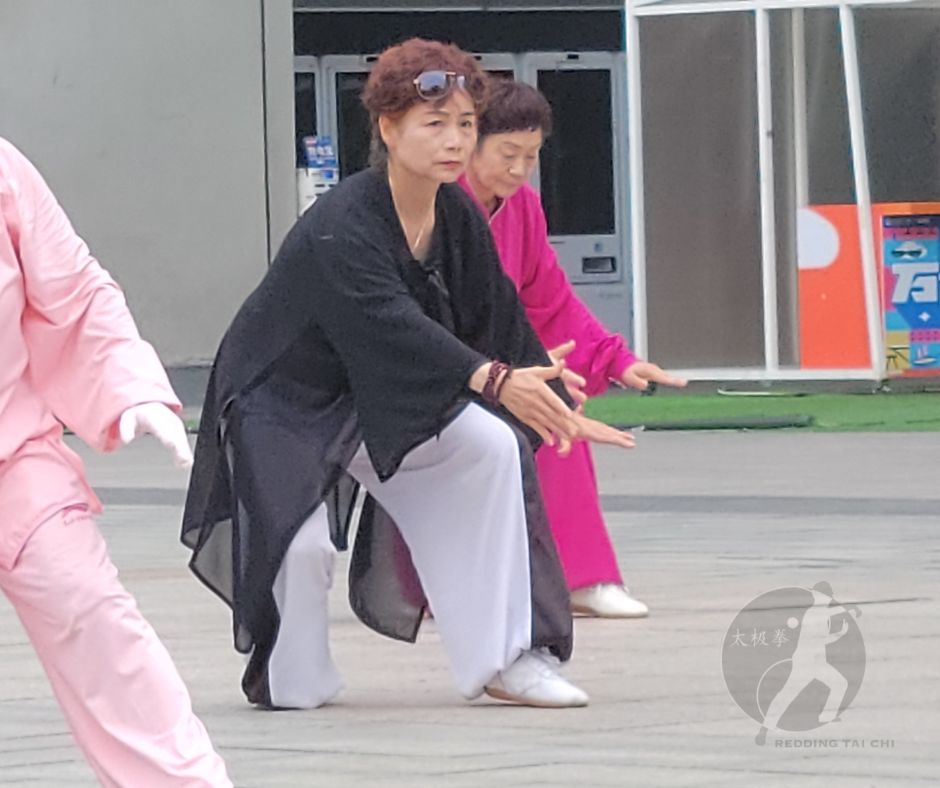
The Ups and Downs of Rising and Sinking Movements
There are many variations in how Tai Chi is taught, and as I frequently mention, if you watch other practitioners start their form, you’ll notice that they often move their arms first without involving their legs. Then, they sink and remain in a low stance throughout the practice. However, staying low without incorporating rising movements (keeping the legs constantly bent) can add strain to the knees. Some styles seem to have more back-and-forth movements, for example, shifting the weight to the front and back to the rear without rising. In our class, following the principles of the Tai Chi classics, we emphasize coordinating the up-and-down movements, that is, rising-and-sinking, of both the arms and the legs for a more unified and fluid motion.
This up and down movement relates to the concept of
“when moving, there is no place that doesn’t move”
which is a fundamental principle in Tai Chi Chuan. It is attributed to the teachings of Wu Yuxiang (1812–1880) who wrote this in his Expositions of Insights into the Practice of the Thirteen Postures. This concept emphasizes the idea of whole-body movement and the interconnectedness of all parts. The concept of the whole body moving as one unit is also expressed in the Tai Chi Chuan Jing by the legendary founder of Tai Chi, Chang Sanfeng. The first sentence reads,
“When moving, all parts of the body should be light, agile,
and interconnected, especially ensuring continuity.”
Therefore, we want to coordinate the rising and sinking movement of both the arms and the legs. We always alternate rising and sinking, and coordinate the movement of both the arms and the legs throughout the form. Everything should happen together. When I sink the legs bend and arms lower, when I rise the legs straighten and arms float up. This up and down movement, or rising and sinking, is done throughout the practice of the form.
Natural Breathing Through Rising and Sinking
The rising and sinking create a natural rhythm in your movements. And since we don’t force our breath in Tai Chi when you practice rising and sinking your breathing will become very natural, especially when you’re doing it alone. I say this because if you are following the instructor’s or leaders movements they may not match up with your own movements. When you practice alone you will find your own body rhythm.
You may notice that when you rise, you have a tendency to inhale, and when you sink, a tendency to exhale. But don’t try to force your breath or think, “I need to exhale (or inhale) at this point.” Instead focus on your movements. When you’re doing this, it will help your Qi flow better, help you relax more, and make the practice feel more meditative. Wu Yuxiang also wrote:
Breathing properly
leads to agility.
The softest
will become the strongest.
The gentle motion of rising and sinking is like the rolling of an ocean wave, naturally creating a relaxed, steady breathing rhythm. This movement helps increase joint flexibility by stimulating blood and Qi flow. With regular practice, you’ll notice improved fluidity and ease in your joints. As you continue, be aware of any areas of stiffness or tension and focus on moving with softness and lightness to encourage relaxation and flexibility.
The Daodejing, Chapter 10 states:
In gathering your Qi to attain suppleness,
Have you reached the state of a newborn babe?
When we practice Tai Chi we are actually nourishing and stimulating the movement of our Qi which enhances our flexibility and overall longevity. Through regular practice that integrates sinking and rising movements, you can gradually achieve and sustain the soft, resilient flexibility associated with youth. With time, these movements help Qi and blood flow smoothly, nurturing joint mobility and relaxation.
If you found this post helpful or inspiring, please give it a like! And if you think others could benefit from it, feel free to share it with friends or fellow Tai Chi practitioners. Thank you for your support!
 Redding Tai Chi
Leave a comment