
Learning to Step in Tai Chi
After completing the initial movements of the Tai Chi form, we take our first step. From the Hold the Ball position, we center our weight onto the right leg and prepare to step forward. It is important to remember to step directly forward and not in front of the other foot.
It is common for students, when told to step straight out, to step in front of their other foot, but this is not the correct position. To learn the correct step, you can use a yardstick to help visualize where your foot placement should be. Start by placing the yardstick pointing forward, directly in front of your left foot. Then, from the initial turn to the right, sink onto your right leg and Hold the Ball. With your left foot, step out straight, keeping it aligned with the yardstick. If you pull your foot back, you should return to a shoulder-width stance.

If you step inward, as many people tend to do, your stance will be too narrow. With a narrow stance, your side-to-side movement becomes less stable, increasing the risk of falling. However, when you step out and maintain a shoulder-width stance, you can shift your weight forward, backward, and side to side with much more stability.
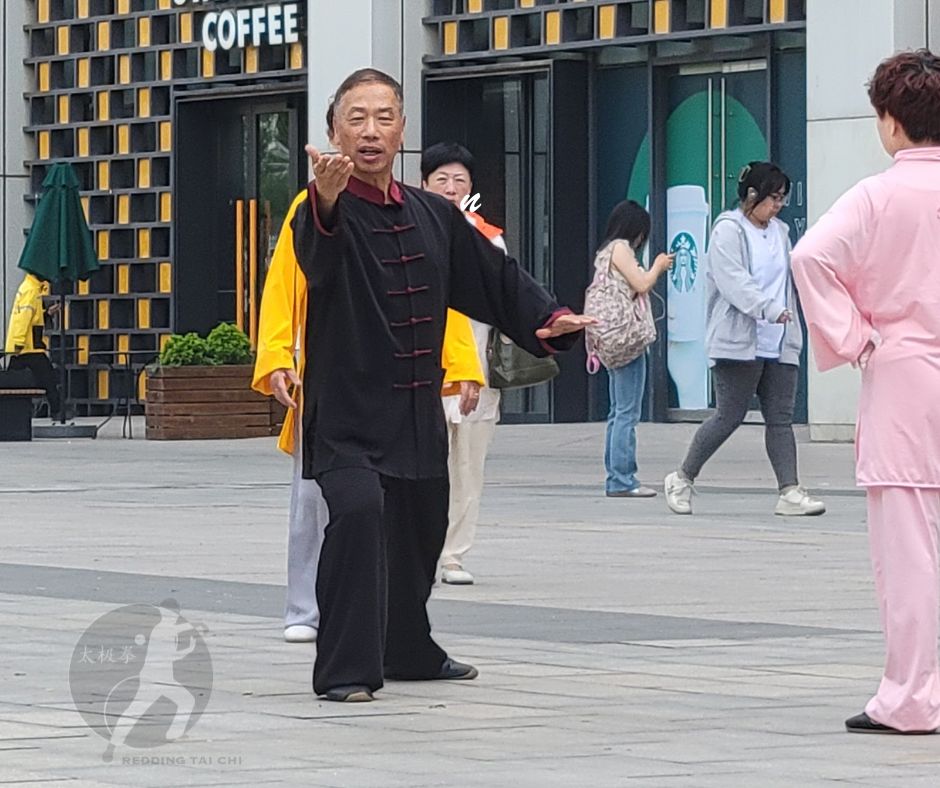
Let’s look at an example. In the photo at the top of the page, the gentleman appears to be demonstrating the movement called Slanting Flight (also known as Diagonal Flying). You can see that if he brings his right foot straight back, it would be next to his left foot—meaning they are not shoulder-width apart. In my opinion, his stance is too narrow for two reasons. First, he lacks stability in side-to-side motion. Second, the application of this movement requires stepping behind the opponent’s leg with the right foot. In this position, he would not have a wide enough stance to apply the movement. The correct way to perform this movement requires a wider stance.
This wider stance is especially useful if you’re going to lift something, as having a strong base of support is crucial for avoiding injuries. Most people hurt their back by keeping their legs too close together while lifting. For example, when you buy garden soil for your yard and put it in the trunk of your car, bending over with a heavy bag or removing it without bending your knees and with your feet close together can easily lead to a back injury. You need to move your legs apart and adopt a wider stance to avoid hurting yourself.
In most cases, if you can lift something while maintaining a wide base of support, your risk of injury is greatly reduced. Keep in mind that it doesn’t take much to hurt your back. Lifting a one-gallon milk carton at arm’s length can do it. In such cases, you need to bring the weight closer to your center to lift it safely.
Step Softly, Step Lightly
The second important concept is to “Step like a Cat.” We’ve all seen a cat slowly moving forward, stalking a bird, getting ready to pounce. The cat takes very light, measured steps, moving slowly and gracefully—very Tai Chi-like. We use that same idea when stepping in Tai Chi.
When stepping out, aim for a light step, not a heavy “kerplunk” followed by shifting your weight forward. The transition between steps should be seamless. Once in position, place all your weight on one leg before stepping out, gently placing your foot down before transferring your weight forward.
Practice Stepping
Start by practicing stepping. Begin with your legs bent, rise slightly, and turn a little to the left while sinking your weight onto the left leg. Then rise again, turn your right foot on the heel, and sink while holding the ball.
Visualize all your weight being centered on your right leg, like a post running from the top of your head down to your heel. Slowly pick up your left foot, and balancing with 100% of your weight on your right leg, step out heel first, allowing it to touch the ground lightly. As you step, keep your weight on the right leg. Avoid shifting your weight forward until your foot is placed.
Improving Skills
If your floor has lines, such as a patterned carpet or flooring, use them to check that you’re stepping straight. Another option is to practice outside on your driveway or sidewalk using the lines in the pavement. You can also use blue multi-surface painter’s tape on the floor or a yardstick to help practice stepping straight.
Stepping lightly takes a lot of practice. Like most things in Tai Chi, it can take days, weeks, months, or even years to become proficient. Whether you’re a beginner or a seasoned practitioner, the goal is to place all your weight on one foot, then step out slowly and lightly with each movement.
Note: This discussion on Learning to Step was adapted from the initial Tai Chi Zoom class on October 9, 2024.
Watch the Video for a Demonstration
If you’re interested in seeing these techniques in action, check out the video below. This second installment in the series is a great supplement to our class lessons and can also be useful for beginners. In the video, I demonstrate the beginning movements of the Tai Chi Long Form, including the Ward-off technique mentioned earlier. You’ll notice that the version I show is slightly different from what is commonly taught today, but it’s rooted in traditional Tai Chi principles.
 Redding Tai Chi
Leave a comment